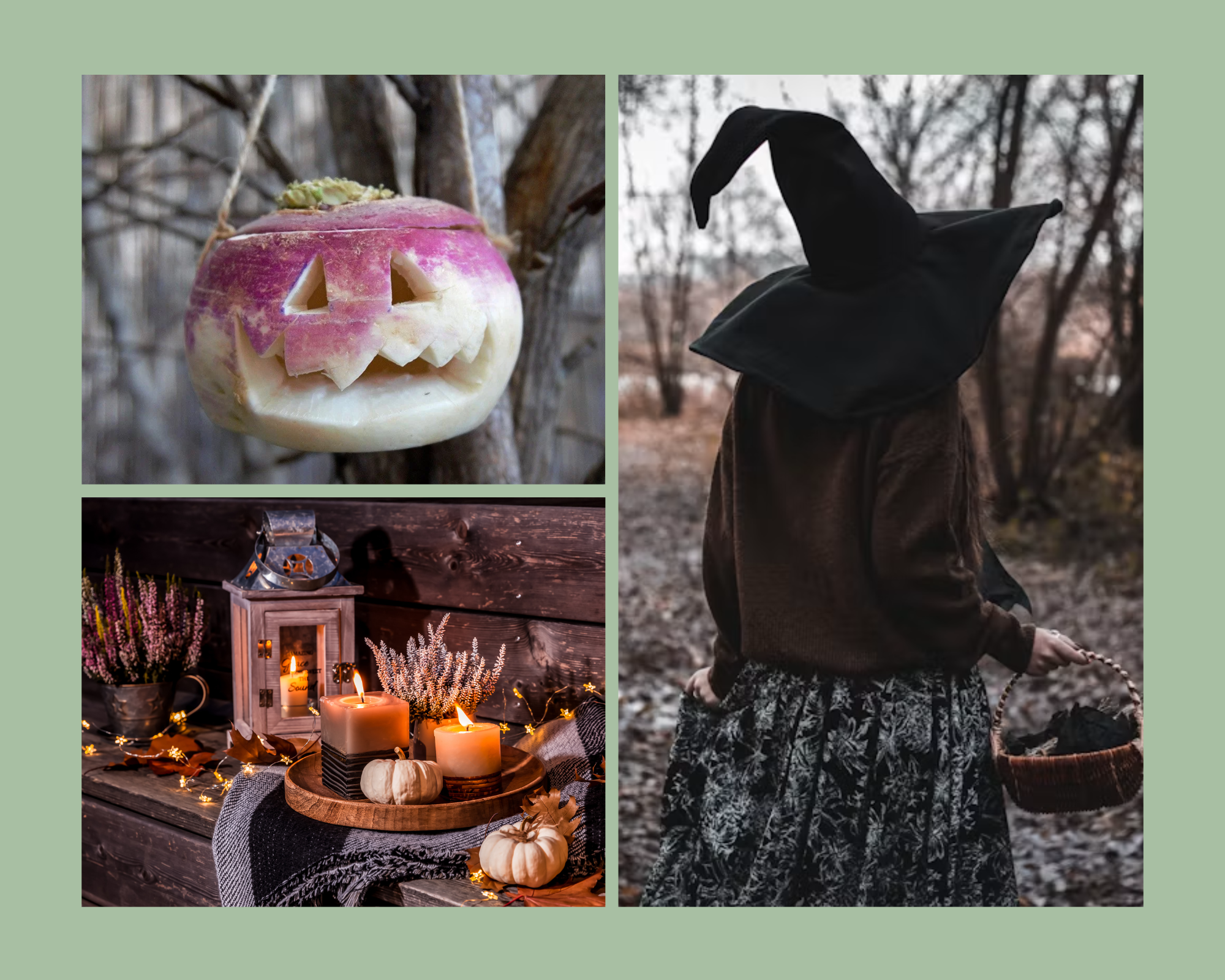

October is the month the wheel truly and more markedly turns. After September’s gentler introduction to change, with its still warm days and amber sunshine, the light is rapidly retreating, the rowans are heavy with berries, and by the end of the month we’ll cross the threshold from the light half of the year into the dark – Samhain, often called the Celtic new year. It’s a month for slowing down even more, really stopping to think about the journey to the darker half of the year, and letting the last of the lighter months go with a touch of ceremony.
Here, in Scotland, our woods and forests are carpeted underfoot with a cornucopia of fallen leaves, and there is more evidence of mushroom growth, sustained by the natural cycle of the dying foliage that nourishes the trees, allowing the buds to emerge in Spring. The patches of gold, russet and tawny we saw against September’s lingering green are spreading now, and the hedgerows, fields, paths and forests are deepening into full autumn colour.

October: What’s in the name?
October was named by the Romans, and simply means “eighth month“. It dates from the earliest Roman calendar, traditionally credited to Romulus, when the year began in March. The Emperor Domitian once renamed it after himself, but Domitianus didn’t outlast him, and October returned. Closer to home, the Celtic languages name the month after the agricultural and natural year. The Scots Gaelic Dàmhair means “the rut” after the rutting season, when stags can be heard to bellow at dawn and dusk. Hydref, which in Welsh means both October, and autumn is thought to come from the word for stag too, as is the Cornish Hedra. The Manx Jerrey-Fouyir and the Irish Deireadh Fómhair both mean “the end of the harvest“: the last chance to gather everything in before winter.
Moon Phases This Month
New Moon: 10th October
A quiet, inward moon early in the month — a good one for setting intentions around what you want to release before Samhain, so that you can grow. New moons in Libra season favour balance, so this is a nice time to ask what’s out of alignment in your life and gently course-correct.
Full Moon: 26th October – The Hunter’s Moon
This month’s full moon carries one of the most atmospheric names in the lunar calendar. Traditionally, it marked the point when the harvest was in and it was time to hunt and store meat for the winter ahead — hence the name. It falls right in the thick of Scorpio season, so expect it to feel intense: a good moon for releasing what no longer serves you, doing a proper autumn clear-out, or simply sitting with a candle and being honest with yourself about the year so far.
Harvest Home Travels Abroad
In rural England, Harvest Home was the celebration held once the last cart of grain had been brought in from the fields. The final sheaf was often woven into a corn dolly and carried home in triumph. The farmer then gave a hearty supper for everyone who had worked the harvest, with songs, cider and ale. The church side of the celebration came later. In 1843 the Reverend Robert Hawker invited his parishioners at Morwenstow in Cornwall to a thanksgiving service, and the idea of decorating churches with sheaves, fruit and bread soon spread across the country.
Here in Scotland, the harvest-home celebration was known as the kirn. The last handful of grain left standing in the field was called the maiden, and cutting it was an honour. It was often given to the youngest girl among the reapers. The maiden was plaited, dressed with ribbons, and carried home to hang in the farmhouse, often above the hearth, until the next harvest. In some places it was fed to the horses at Yule or at the first ploughing of the new year, so that the luck of one harvest carried into the next.
In parts of the Highlands a late harvest brought a different figure: if the last sheaf was cut after Halloween it became the cailleach, the old woman of winter. No farmer wanted to be left with her, so neighbours raced to finish first. Once the work was done, the kirn itself followed, with a supper in the barn, whisky, fiddle music and dancing late into the night.
When English and Scottish settlers crossed the Atlantic, they took these customs with them. The famous 1621 gathering at Plymouth, Massachusetts, now remembered as the “first Thanksgiving”, was very much in the spirit of a harvest home. It was a feast shared once the crops were safely gathered. Over the next two centuries, local days of thanksgiving grew into a national holiday. In 1863 Abraham Lincoln set the last Thursday of November as a day of thanks, and Americans still celebrate it in late November. Harvest suppers and church services also carried on in their own right in many American communities, especially in rural New England and Pennsylvania.
Canada’s story is closer to our October calendar. Loyalist families moving north after the American Revolution, and later waves of British and Scottish settlers, brought harvest suppers and church harvest festivals with them. Canada’s Thanksgiving became an annual holiday in 1879. Since 1957 it has been fixed on the second Monday of October, which this year is Monday 12th October. Many Canadian churches still decorate for harvest in the old way, with pumpkins, apples and wheat sheaves.
So this October, when Canadian friends sit down to their Thanksgiving tables, they’re keeping a tradition that grew from the same roots as our own harvest festivals, from the English harvest supper to the Scottish kirn.
A Guide to Samhain
Samhain (pronounced “SOW-in”) falls on the 31st and marks the end of the harvest season and the start of the darker half of the year. It’s often thought of as the origin of Halloween, but at its heart it’s simpler than that — a time to honour what’s passed, both in nature and in our own lives, and to acknowledge the veil between worlds is thinner than usual.
Making it work for you, in practice: You don’t need an elaborate ritual for this to mean something. Samhain can be as simple as lighting a candle for someone you’ve lost, having a quiet dinner that reflects on the year, or spending an evening by candlelight instead of electric light.
Key practices: Ancestor reflection (setting a place at the table, or simply speaking a name aloud), a proper seasonal clear-out to mark the ending of the year’s cycle, and divination of any kind — this has always been considered a night when the veil is thin enough for that sort of quiet inward work.
Symbols of Samhain: Turnips and pumpkins (originally turnips were carved in Scotland long before pumpkins arrived), apples, bonfires, the colours black and orange, and of course the rowan and hazel trees, both considered protective at this time of year.
Guising, not trick-or-treating: Long before “trick or treat” made its way over from America, Scottish children went “guising” — dressing up in disguise, traditionally to blend in with the spirits believed to be wandering that night. The key difference is that guising isn’t just knocking and asking: children had to earn their treat with a “party piece” — a song, a poem, a joke, or a dance — before being given fruit, nuts, or a few coins. It’s a lovely, more theatrical tradition than the modern version, and one worth keeping alive if you’re marking Samhain with children (or, honestly, if you fancy reviving the party-piece tradition with adults too).
A Simple Samhain Ritual
You don’t need anything more than a candle, a bit of quiet, and maybe a pen and paper for this.
- Light a candle as the sun goes down, and take a few slow breaths. This marks the crossing point — the last of the light half of the year giving way to the dark.
- Reflect on the year’s harvest. What have you grown, learned, or gathered since spring? You don’t need to write an essay — even a few honest sentences will do.
- Write down what you’re ready to release before the new cycle begins — an old habit, a worry, something you’ve been carrying that no longer serves you. Read it back once, then either burn it safely in the candle flame or tear it up.
- Take a moment for anyone you’ve lost — a person, a pet, even a version of yourself from earlier in the year. You could speak their name aloud, set a small place for them at the table, or simply hold them in mind.
- Close with an intention for the dark half of the year ahead — something quieter than a goal, more like a feeling you want to carry through the winter months.
Blow out the candle when you’re ready, and let that be the end of it — no need to overcomplicate what’s really just a moment of honest reflection.
A ritual that is simple, intentional, and quiet will always beat elaborate and performative.
What’s Happening in the Sky
We spend most of October moving between two very different energies. Until the 22nd, we’re still in Libra season — all about balance, harmony, and relationships. From the 23rd, the sun moves into Scorpio, and the tone shifts noticeably: deeper, more intense, more drawn to what’s hidden beneath the surface. It’s not a coincidence that Scorpio season lines up with Samhain — both are about facing the shadow rather than looking away from it.
Nature Notes: What to Look Out for This Month
October is one of the richest months for noticing in Scotland, if you know where to look.
This is peak season for the red deer rut — head to the Highlands, the Trossachs, or anywhere with a resident herd, and you’ll likely hear stags roaring across the glens as they compete for mates. It’s one of the most dramatic things you can witness in the Scottish countryside, and well worth an early morning trip if you can manage it.
Keep an eye on the skies too: pink-footed geese arrive back in Scotland from Iceland and Greenland through September and October, and their V-formations and honking calls overhead are one of autumn’s most reliable signs.
On the ground, it’s fungi season in earnest — woodland floors are carpeted with all sorts, from fly agaric to puffballs, so this is a lovely month for a slow forage-and-photograph walk (never eat anything you can’t confidently identify). The rowan trees will be dripping with red berries, traditionally seen as protection against ill will, and the leaves are properly turning now — gold, amber, and rust across the Cairngorms and beyond.
A Few Journal Prompts for the Month
- What am I ready to release before the year turns?
- What has this year’s “harvest” actually looked like for me — what have I grown, learned, or gathered?
- Who or what am I grieving, and how can I honour that gently this month?
- Where in my life do I need more balance (Libra), and where do I need to go deeper (Scorpio)?
- What does my ideal, simple Samhain look like this year?
However you choose to mark the turning of the season, I hope October brings you some proper stillness before the dark half of the year begins.
Llewellyn is one of the publishers I trust most, and their Sabbat Essentials series is, for me, essential for the bookshelf of anyone living by the wheel of the year. This Samhain guide goes through the history and folklore of the festival, with simple rituals, seasonal recipes, crafts, and correspondences for colours, herbs and crystals. It’s easy to dip into whether you’re marking Samhain for the first time or have celebrated it for years, and it’s the book I come back to every October.
Samhain: Rituals, Recipes & Lore for Halloween – Diana Rajchel (Llewellyn’s Sabbat Essentials) https://amzn.to/4jpaTKW
If the Llewellyn guide is my practical companion for Samhain, this is the one I reach for when I want the old stories. The Wyrd Sabbat Guides bring together writing on each festival’s history and folklore by scholars and folklorists from the 19th and early 20th centuries and earlier. That gives the book a lovely, authentic, slightly antiquarian feel. Alongside the history you’ll find traditional spells, seasonal crafts and recipes for marking the night. It’s a beautiful little book to curl up with by candlelight as the dark half of the year begins, and a wonderful partner to the more modern guides on your wheel-of-the-year shelf.
Samhain: Traditional Magic, Recipes, and Tales for Halloween – Wyrd Books (Wyrd Sabbat Guides) https://amzn.to/4xC0WgZ
This is the book I pick up when I want to bring the season indoors. It follows autumn month by month, from September to November, with cosy recipes such as cardamom ginger apple butter and apple pancakes with caramel syrup, alongside simple projects like making a wreath or setting a candlelit table with gourds. Tom McGovern’s photographs of orchards, pumpkin patches and golden afternoons make it a joy just to leaf through. It has an American flavour, so you’ll find apple picking and pumpkin patches in here, which pairs nicely with the story of how Harvest Home travelled across the Atlantic. It’s a lovely, gentle companion for anyone who wants to slow down and savour autumn at home.
From Harvest to Home: Seasonal Activities, Inspired Décor, and Cozy Recipes for Fall – Alicia Tenise Chew, photography by Tom McGovern https://amzn.to/4rLzM65
For pure October baking and cooking, this one has a lovely nostalgic feel. It’s full of vintage-inspired Halloween recipes (76 of them), the kind of treats that remind you of childhood parties and kitchens that smelled of spice and toffee. There are eight make-ahead party menus, which make hosting a Samhain supper or a guising night so much easier. I especially love the keepsake pages, where you can note down your own family memories and recipes, so the book becomes part of your own October traditions over the years.
October Kitchen Memories: A Vintage-Inspired Halloween Cookbook – Alexis Mikayla https://amzn.to/4ymtcVK
As an Amazon Associate I earn from qualifying purchases. Some of the links in this post are affiliate links, which means I may earn a small commission if you make a purchase through them, at no extra cost to you. It genuinely helps keep this blog going, so thank you if you do choose to use them. That said, please do also consider supporting small, independent businesses and your local bookshop where you can — it makes a real difference to them, and often you’ll find something lovely you wouldn’t have otherwise.
Here is a link to my Benable page: https://benable.com/brackenandblossom
If you are not familiar with Benable, it’s where I create and share curated shopping lists — a bit like a digital wishlist you can browse, save, and shop from directly. It’s where all my witchy glamour, beauty, and home recommendations live in one place, so you can always find my full, up-to-date picks there rather than just what’s in a single blog post. Again, this includes some affiliate links, which means I may earn a small commission if you shop through them, at no extra cost to you. I only ever recommend things I genuinely use and love, so you can trust these picks are the real deal, not just filler.
Slow down and stay captivated,
Rowan 🍂
.

Leave a Reply