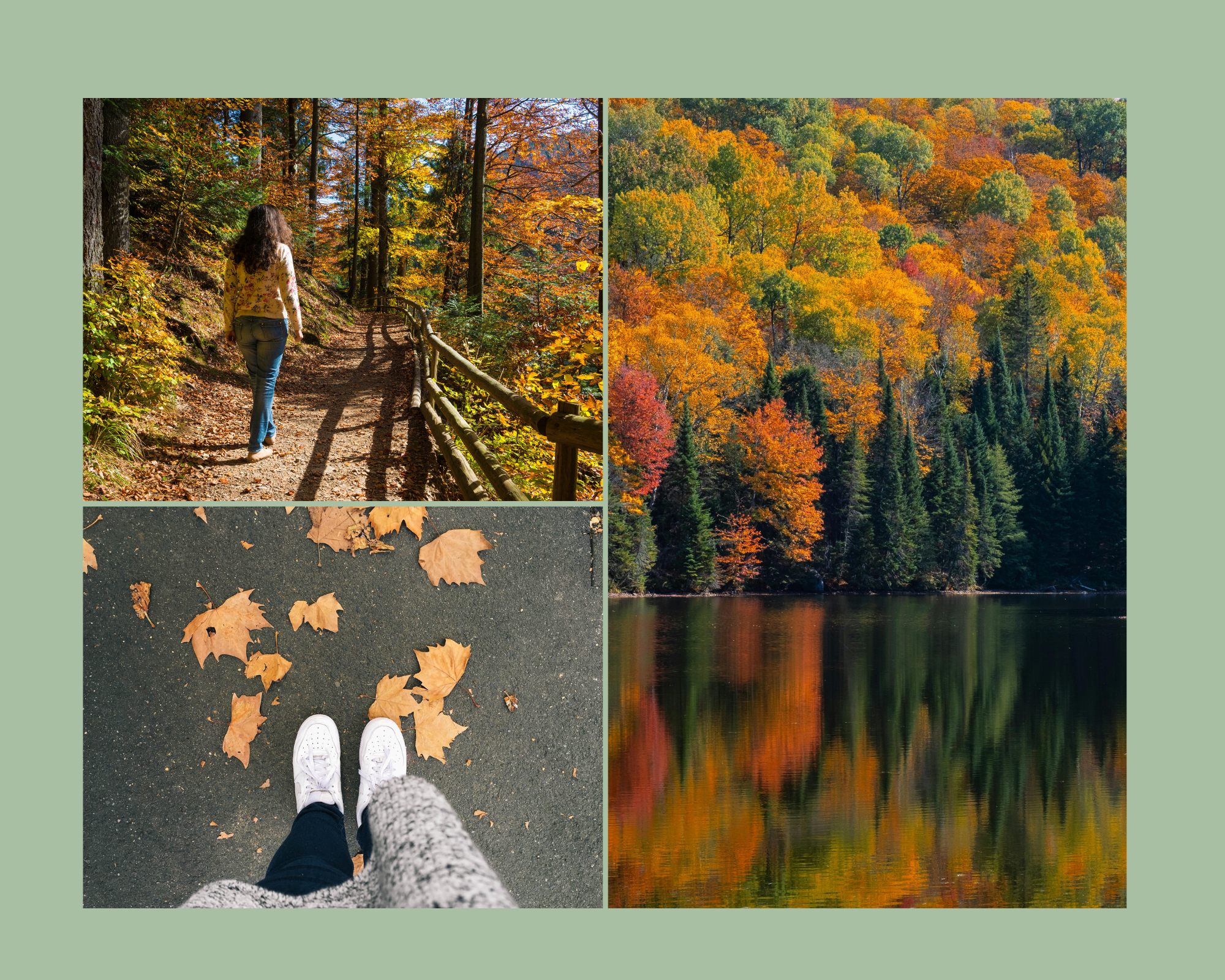

There’s a reason so many of us feel the urge to go outdoors the moment autumn arrives here. Scotland does this season very well indeed — mist sitting low over the glens, woodland floors turning to copper and rust, the quiet settling over a forest once visitors have thinned out and the light’s gone low and golden. If you’ve ever stood in the middle of it and felt something shift, you’ll know exactly what I mean.
Today I want to talk about what makes a walk atmospheric – not just a walk, but the kind that stays with you – and share how I’m building a bit of ritual around mine this autumn, from forest bathing to foraging, to actually slowing down enough to notice nature in its splendour.
What Makes Scotland so Atmospheric in Autumn
Scotland has a way of doing autumn that seems almost deliberate. The combination of ancient woodland, dramatic light, and weather that changes its mind every twenty minutes means no two walks ever feel quite the same.
A few things I think make it so special here:
- The light. Low autumn sun through bracken and birch does something no other season manages – there is an amber glow, even on a grey day.
- The mist. Glens, lochs and forests holding onto morning mist well into the day, especially somewhere like the Trossachs or the Cairngorms, giving everywhere an almost otherworldly quality.
- The quiet. Summer crowds fade, and what’s left is birdsong, wind in the trees, and your own footsteps on wet leaves.
- The folklore. So much of Scotland’s landscape carries old stories – standing stones, ancient woods, wells and cairns – and autumn, with its harvest and its thinning veil, feels like the season those stories were made for.
What Makes a Walk Atmospheric?
I think the difference between “a walk” and an atmospheric one comes down to attention. You can walk the same path twice – once rushing, checking your phone, thinking about your to-do list, and once actually there – and they’ll feel like entirely different experiences.
A few things that tend to shift a walk into something more:
- Going somewhere with texture – old woodland, water, changing terrain – rather than a flat, straight path
- Timing it for low light – early morning or that last hour before dusk – rather than the middle of the day
- Leaving your headphones at home, at least for part of your walk
- Having no particular pace to keep – this isn’t exercise, it’s a practice
Walking in The Woods: Forest Bathing
If you haven’t come across it before, shinrin-yoku – forest bathing – is a Japanese practice built entirely around this idea: that simply being present among trees, using all your senses rather than your thoughts, is genuinely restorative. No targets, no destination to reach – just being present.
A simple way into trying this, if you want to try it on your next woodland walk:
- Stop walking for a moment. Properly stop.
- Notice five things you can see – the way light falls through the canopy, the colour of the leaf litter, moss on a fallen branch
- Notice what you can hear layered underneath the obvious sounds – wind higher up in the branches, something rustling further off
- Touch something – bark, moss, a fallen leaf – and actually feel the texture
- Breathe in deeply where you can – that unique smell of damp earth and decaying leaves, perhaps with smoke coming from someone’s chimney
There’s something in Scottish woodland especially – ancient Caledonian pine, oak, birch – that makes this easy to fall into. I love the feeling that you are always on the edge of discovering something in a forest, but discovering is only possible if you slow down.
Slowing Down, Noticing, and Glimmers
I love the idea of “glimmers” — the opposite of a trigger — small moments that spark a flicker of calm, safety, or joy. Autumn walks are full of them, if you slow down enough to catch them:
- A robin appearing on a branch just ahead of you
- The crunch of the first frosted leaves underfoot
- Steam rising off a loch in the early morning
- Spotting a single, perfect fungi cluster on a rotting log
- The smell of woodsmoke drifting from somewhere in the distance
None of this requires anything from you except paying attention. That’s the whole practice, really.
A Note on Foraging
Autumn in Scotland is also foraging season – brambles, rowan berries, rosehips, chestnuts, and (with caution) mushrooms. It’s such a lovely way to connect more deeply with a walk, but it comes with some genuinely important disclaimers:
- Never eat anything you can’t identify with complete certainty – and ideally cross-reference with more than one reliable source or an experienced forager
- Fungi foraging in particular carries real risk – some edible and poisonous species look very similar, and a mistake can be serious or fatal. If in doubt, just leave it
- Forage responsibly – take only what you need, leave plenty for wildlife, and be mindful of local bylaws (some areas, including parts of Scotland, restrict or prohibit foraging). I like to say a quick thank you too, to whatever spirits dwell there
- Check land access rules – Scotland’s right to roam is generous, but foraging etiquette and landowner respect still matter
- This post is about the experience of foraging as part of a walk, not a foraging guide – please treat it that way, and always verify with a proper foraging reference or expert before eating anything you’ve gathered
Onto the Walks
I’ve picked a handful of routes for this post that I think capture everything above – atmosphere, woodland, a bit of foraging potential, and some Scottish autumn magic. There are honestly far too many incredible walks to fit into one post, so consider this part one – I’ll be back with a second instalment covering more areas of Scotland soon. I have included links to the All Trails website (there is an app available too), which for me is absolutely indispensable
Kelvingrove Park Circular — Glasgow
Proof that you don’t need to leave the city for an atmospheric autumn walk. Kelvingrove’s tree-lined paths turn properly golden this time of year, and with the Kelvingrove Art Gallery, the Botanics close by, and Glasgow University’s spires rising above the trees, there’s as much atmosphere in the architecture and history here as there is in the woodland itself. A gentle circular route, easy to fit into an afternoon, and a lovely one for practising a bit of slow noticing without needing a car or a full day free.
Water of Leith Walkway — Edinburgh
A longer one, and one of my favourites for an autumn day out. The path follows the river right through the city, past old mills, weirs, and the odd heron if you’re lucky, with the trees along the banks turning beautifully this time of year. It’s also a walk with plenty of reasons to stop — Dean Village and Stockbridge in particular are full of lovely cafés and spots for a coffee, a bite to eat, or a warming drink partway round, so you can make it as short or as leisurely as you like. A lovely one to break up with a proper pause rather than walking straight through.
Gifford to Yester Castle — East Lothian
This one might be my favourite for atmosphere alone. The walk sets off from the pretty village of Gifford, winding through woodland on the Yester estate before reaching the ruins of Yester Castle – and beneath it, the eerie stone chamber known as Goblin Ha’, said to have been built with the help of goblins summoned by a local wizard. It’s the kind of route that makes the folklore in this post feel very real underfoot: old trees, crumbling stone, and a sense of stepping into a story. Gifford itself is worth lingering in afterwards too, with a couple of lovely spots to warm up with a coffee before heading home. See my pictures below from our walk here last week.
Gifford in East Lothian in all its autumnal glory – I picked up a few treasures in the woods for my Samhain altar display – I’ll share with you in the next post…

The remains of Yester Castle and Goblin Ha’ (bottom right) – maybe its my imagination, or the camera flash, but is there something gathering in the Goblin Ha’?

Devilla Forest Circular — Fife
If foraging is what draws you outdoors this autumn, this is the one to bookmark – Devilla is an absolute must, with plenty to find for those who know what they’re looking for (foraging disclaimers very much apply here!). But it’s also just a brilliantly atmospheric forest in its own right, with a couple of genuinely spine-tingling features tucked into the trees: an old icehouse, and a crumbling crypt that feels like it belongs in a folk tale rather than a Fife forest. A proper autumn walk in every sense.
I’ve used AllTrails for years and it’s always the first thing I open when planning a walk. On average I log around 300 km a year with it, from quiet woodland loops to longer days in the hills. I upgraded to AllTrails+ and the offline maps have been worth it on their own. Phone signal disappears quickly once you’re up a Scottish glen, and it’s reassuring to know the route is still there on my screen. I also love reading other walkers’ recent reviews before I set off, so I know whether the path is boggy, the burn is in spate, or the bracken has turned that perfect autumn copper. And it’s not only Scotland: I’ve used it to find walks in Greece, Spain and Prague too, so it always comes on holiday with me. If you’re heading out on any of the walks in this post, or anywhere further afield, it’s a lovely companion to have in your pocket: https://alltrails.pxf.io/c/7838626/1918532/22353
A couple of books to have on hand if you want to take this a little deeper. Where you can, I’d always encourage picking these up secondhand or through a local, independent bookshop rather than the big retailers — it’s kinder to your pocket, kinder to the planet, and there’s something rather lovely about a book on slow, mindful living having had a life before it reaches you too.
The Art of Forest Bathing by Aurora Munro
A practical, science-backed guide to forest bathing, written by a self-confessed former skeptic. It walks through a simple step-by-step method for practicing it properly, plus tips on finding the right spot whether you’re rural or urban, journal prompts, and a guided meditation to try. Genuinely accessible rather than woo-woo — a good companion read alongside this walks guide. https://amzn.to/46pR7aQ
Noticing: Intimate Encounters with the Natural World by Richard Louv
A gentle, thoughtful exploration of what it actually means to pay attention to nature — sensory, scientific, and even spiritual ways of seeing a tree properly or getting to know a fox, rather than just walking past it. Louv (best known for Last Child in the Woods) blends personal essay with neuroscience and Indigenous knowledge, and coins the lovely term “bioenchantment” for what happens when you slow down enough to really look. A beautiful companion for anyone trying to notice more on their own walks — glimmers included https://amzn.to/4xsvul0
Glimmers: Tiny Moments to Transform Your Life by Nadia Narain and Katia Narain Phillips
The book behind the word — glimmers are the small, good moments (sunlight through leaves, birdsong, a stranger’s smile) that calm your nervous system rather than trigger it, and sister authors Nadia Narain and Katia Narain Phillips (of Self-Care for the Real World fame) blend nervous system science with genuinely practical, down-to-earth exercises for noticing more of them. A perfect pairing with the “glimmers” angle in this post — teaches you exactly what you’re looking for on a slow autumn walk. https://amzn.to/46ZsQZ9
The Magic of Mushrooms by Sandra Lawrence
Published by the Royal Botanic Gardens, Kew, this beautifully illustrated book explores fungi’s long history in folklore, superstition, and traditional medicine — from fairy rings and witches’ butter to healing remedies and the mythology of magic mushrooms. Part natural history, part cultural journey, it’s a lovely read for anyone drawn to the earthy magic of the forest floor. https://amzn.to/4haUKGA
Witch’s Forest by Sandra Lawrence
Another beautiful entry in Sandra Lawrence’s Kew series, this one turns to trees — exploring the magic, folklore, and traditional remedies woven around woodlands through the ages. From sacred groves to age-old superstitions and herbal wisdom, it’s a rich, atmospheric wander through the forest’s darker, more mystical side. https://amzn.to/4ygYFsN
As an Amazon Associate I earn from qualifying purchases. Some of the links in this post are affiliate links, which means I may earn a small commission if you make a purchase through them, at no extra cost to you. It genuinely helps keep this blog going, so thank you if you do choose to use them. That said, please do also consider supporting small, independent businesses and your local bookshop where you can — it makes a real difference to them, and often you’ll find something lovely you wouldn’t have otherwise.
Slow down and stay captivated,
Rowan 🍂
.

Leave a Reply