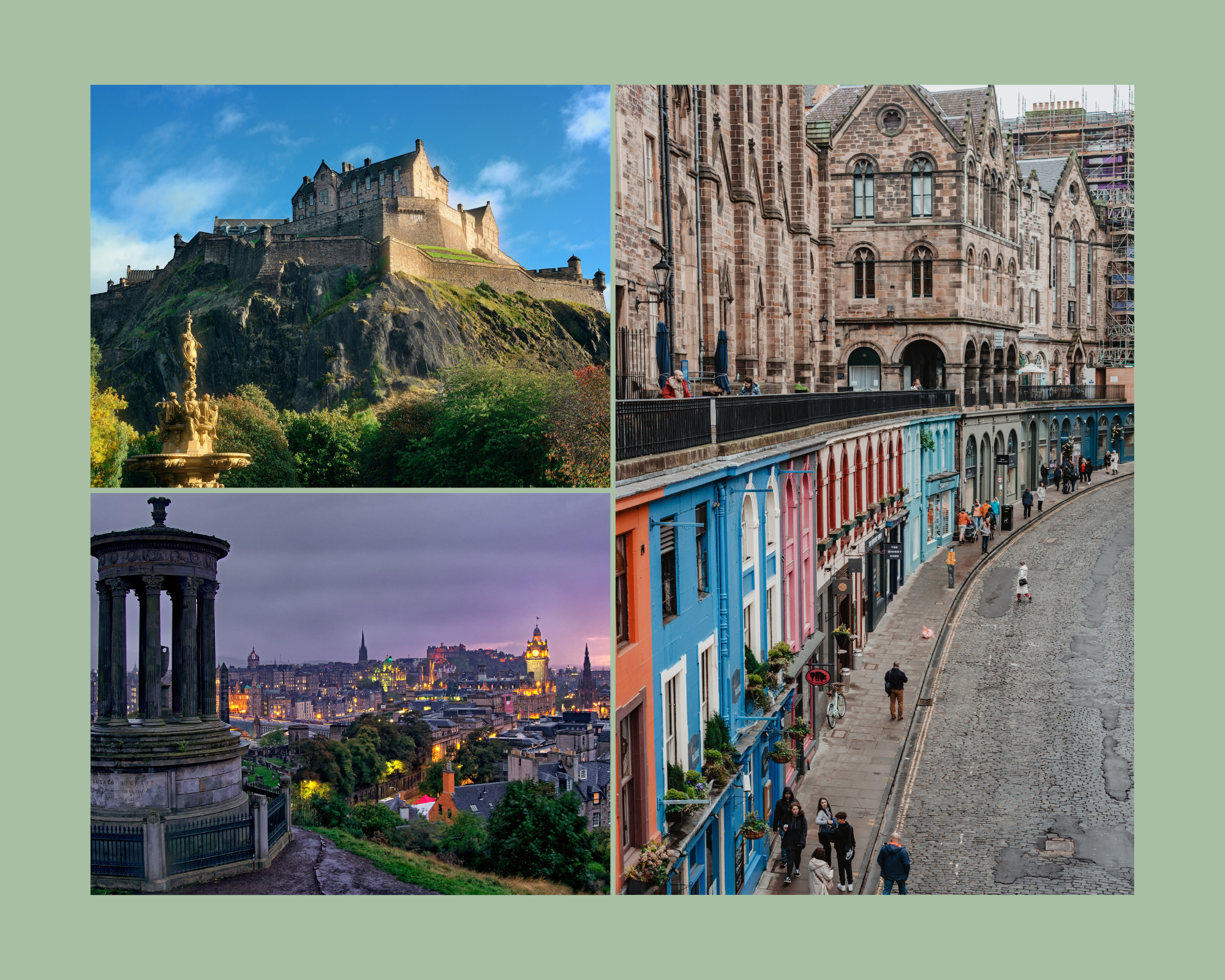

There is no better time to fall in love with Edinburgh than in the Autumn. As the light softens and the evenings draw in earlier, the city’s medieval bones seem to rise closer to the surface — mist gathers in the winding, lamplit closes, the castle disappears and reappears through low cloud, and the whole Old Town feels as though it’s holding its breath before winter.
This is the first post in a series exploring Scotland’s most atmospheric places to visit this Autumn, and there was only one place to start: Edinburgh, a city built quite literally on the strata of its own history.
Welcome to Edinburgh in Autumn
Edinburgh is really two cities in one. The Georgian elegance of the New Town, with its wide streets and neoclassical façades, sits in polite contrast to the Old Town across the valley — a tangle of tenements, wynds, and closes climbing the volcanic ridge between Edinburgh Castle and the Palace of Holyroodhouse.
It’s the Old Town that Autumn suits best. The Royal Mile runs like a spine down the middle of it, but the real character lives in the narrow closes branching off either side — many barely wide enough for two people to pass — that once housed entire communities stacked storey upon storey.
By late September the trees in Princes Street Gardens and along the Water of Leith are turning gold, the crowds have thinned since the Fringe, and the shorter days mean it’s dark by early evening — which, in a city this steeped in ghost stories and grim history, only adds to the effect. Pack a warm coat and comfortable shoes for the cobbles, and give yourself at least two or three days to do the city justice.

Princes Street Gardens in Autumn.
Museums and Places Steeped in History
Edinburgh’s museums lean unapologetically into its darker chapters, and that’s exactly what makes them so compelling in Autumn and its deepening shadows.
The Real Mary King’s Close, tucked beneath the City Chambers on the Royal Mile, is the closest thing Edinburgh has to a time capsule. It’s a genuine warren of 17th-century closes and wynds that were built over rather than demolished, preserving homes, workshops, and streets almost exactly as they were left. Costumed guides lead you through the preserved rooms, telling the stories of the plague, of desperate poverty, and of the residents who never left — the close has a long-standing reputation as one of the most haunted spots in the city. It’s an easy walk-in visit but tours do get busy, so booking ahead is worth it.
Surgeons’ Hall Museums, a short walk south on Nicolson Street, is where Edinburgh’s medical history and its darkest true crime story meet. This is one of Scotland’s oldest museums, holding over 500 years of surgical history — and it’s here that the legacy of Burke and Hare looms largest. In 1828, William Burke and William Hare murdered sixteen people over roughly ten months in the West Port area, smothering their victims and selling the bodies to the anatomist Dr Robert Knox for dissection. The case exposed just how desperate the trade in cadavers for anatomy schools had become, and eventually forced Parliament to pass the Anatomy Act of 1832. Burke was hanged in 1829 in front of a crowd of some 25,000 people, and — in a fittingly grim irony — his own skeleton was dissected and is still held by Edinburgh’s medical school. The museum’s collection isn’t for the faint of heart, but it’s a genuinely fascinating look at how the city’s appetite for scientific progress had a very dark underside.
Greyfriars Kirkyard, just off Candlemaker Row, is worth an unhurried wander even before dusk. Among its crowded, crumbling tombstones sits the Covenanters’ Prison and the Black Mausoleum, resting place of Sir George “Bloody” Mackenzie — a 17th-century judge blamed for the deaths of hundreds of Covenanter prisoners. Since a break-in at his tomb in the late 1990s, visitors and paranormal investigators have reported the “Mackenzie Poltergeist,” with dozens of alleged attacks recorded over the years. Whatever you make of it, the kirkyard’s atmosphere after sunset needs no embellishment.

Greyfriars Bobby, the loyal guardian of Greyfriars Graveyard.
If you only have time for one big-ticket attraction, Edinburgh Castle itself is unmissable — not just for the views over the New Town, but for its own centuries of sieges, prisoners, and executions.

Edinburgh Castle.
Deacon Brodie’s Double Life
No account of Edinburgh’s dark history is complete without Deacon William Brodie. By day, Brodie was a respected city councillor, cabinet-maker, and Deacon of the Wrights’ guild — a pillar of Edinburgh society. By night, he ran a secret life as a burglar, using his trade to copy his clients’ keys and rob the very houses he’d been trusted to work in, all to fund his gambling and two secret mistresses. He was finally caught after a botched robbery at the Excise Office in 1788, arrested in Amsterdam, and hanged that October — reportedly on a new style of gallows that some accounts say he had a hand in designing himself. Brodie’s double life is widely credited as one of the inspirations for Robert Louis Stevenson’s Dr Jekyll and Mr Hyde, and his legacy is very much alive on the Royal Mile today, where a pub bearing his name still stands.
Dean Village and the Walk Down to Leith
Just west of the New Town, tucked below street level along the Water of Leith, Dean Village is one of Edinburgh’s prettiest surprises — and, understandably, one of its most Instagrammed corners of the city. Once a working milling village dating back to the 12th century, its huddle of gabled stone buildings and converted grain stores, along with the striking red sandstone tenement Well Court, look almost like a film set beside the slow-moving river. A fire in 1824 hastened its decline as an industrial hub, and what’s left today is a hushed, almost secret pocket of the city that feels a world away from the Royal Mile, despite being only a few minutes’ walk from it.

Dean Village.
From Dean Village, the Water of Leith Walkway follows the river all the way down to the coast, and it’s one of the loveliest, quietest ways to spend an autumn afternoon in the city — russet leaves overhead, herons on the water, and barely another soul about once you’re past the first bridge. Follow it far enough and you’ll arrive in Leith itself, Edinburgh’s historic port, with records of a settlement and harbour here stretching back to the 12th century, making it one of Scotland’s oldest ports. Leith spent centuries as Edinburgh’s working harbour and, later, its own separate burgh, before being absorbed back into the city in 1920 — and it’s kept a distinct, salty character of its own ever since. From the waterfront at The Shore, you can look out across the Firth of Forth to the hills of Fife on a clear day, the water often catching that same soft autumn light that makes the whole walk worth the effort.

The port of Leith.
Leith has also quietly become one of the best places to eat in the city. Restaurant Martin Wishart, which has held a Michelin star for over two decades, remains the destination for a serious tasting menu, while Fishers, housed beneath the old Signal Tower on The Shore — built in 1685, and in its time a windmill and later a Napoleonic-era lookout — has been a local institution for seafood for years. For something more casual, Brown’s of Leith, a striking new food hall set inside a former dockside engineering works on Custom Lane, brings together pizza, seafood, small plates, and a working gelateria and bakery all under one industrial roof, right on the water.
Where to Shop and Eat Among the Shadows
For dinner, nothing matches The Witchery by the Castle, tucked into a cluster of 16th-century buildings right at the castle gates. The Original Dining Room is oak-panelled and candlelit, dripping with baroque detail, while the Secret Garden downstairs offers an equally theatrical, plant-filled alternative reached by a winding stone stair. The menu keeps to Scottish classics done exceptionally well — think Scotch beef, lobster thermidor — and the whole experience feels like stepping into another century. Book well ahead, especially for an autumn evening visit.

The Witchery by the Castle.
For something more low-key, Deacon Brodie’s Tavern on the Lawnmarket is worth a stop for a drink in Brodie’s honour, and Maggie Dickson’s pub in the Grassmarket has its own remarkable story: Maggie Dickson was hanged there in 1724 for concealing a pregnancy, was declared dead — and woke up in her coffin on the way to burial. She lived for decades afterwards, earning the nickname “Half-Hangit Maggie.”
The Grassmarket and neighbouring Victoria Street, with its curved row of colourful shopfronts, are the best spots for browsing — independent boutiques, whisky and cheese shops, and secondhand bookshops line the streets, all with Edinburgh Castle looming above. It’s a fittingly atmospheric place to pick up a souvenir before heading back out into the mist.
Next in the Atmospheric Scotland series: we head west to explore Scotland’s largest city: Glasgow.
Edinburgh is best explored slowly, but a guided walk can show you corners you’d never find on your own. I like browsing GetYourGuide for small-group tours, castle tickets and gentle day trips, so I can plan a little and leave the rest of the day free to wander: https://gyg.me/cjy3HWgR
Here is the most up to date Lonely Planet guide for Edinburgh, and I’d recommend Lonely Planet as one of the most comprehensive guides out there: Lonely Planet Pocket Edinburgh by Mike MacEacheran https://amzn.to/46MH3Zk
This is a lovely book which would be an ideal companion when travelling to the city, adding to the atmosphere as you go: Edinburgh After Dark: A Visitor’s Guide to Ghosts, Witches & the Paranormal by The Scottish Traveller https://amzn.to/4r2ZrXd
Another lovely guide book, this time guiding you through some of the less obvious walking routes, where you will be guaranteed to see some interesting corners of the city: A-Z Edinburgh Hidden Walks by Alan Sharp: https://amzn.to/4r2nky4
A sweeping account of Scotland’s capital, tracing Edinburgh’s story from its ancient origins right through to the present day. Moffat brings his gift for storytelling to the city’s dramatic past, making it a compelling read for anyone with a love of Scottish history: Edinburgh: A New History by Alistair Moffat: https://amzn.to/3TArUYa
A gorgeous collection showcasing Edinburgh through the eyes of the artists who’ve painted, drawn, and photographed it — a lovely visual companion for anyone who loves the city, rather than a straight read: The Edinburgh Art Book by Emma Bennett: https://amzn.to/4yxwm94
As an Amazon Associate I earn from qualifying purchases. Some of the links in this post are affiliate links, which means I may earn a small commission if you make a purchase through them, at no extra cost to you. It genuinely helps keep this blog going, so thank you if you do choose to use them. That said, please do also consider supporting small, independent businesses and your local bookshop where you can — it makes a real difference to them, and often you’ll find something lovely you wouldn’t have otherwise.
Here is a link to my Benable page: https://benable.com/brackenandblossom/an-atmospheric-autumn-in-scotland-edinburgh-recommendations
If you are not familiar with Benable, it’s where I create and share curated shopping lists — a bit like a digital wishlist you can browse, save, and shop from directly. It’s where all my witchy glamour, beauty, and home recommendations live in one place, so you can always find my full, up-to-date picks there rather than just what’s in a single blog post. Again, this includes some affiliate links, which means I may earn a small commission if you shop through them, at no extra cost to you. I only ever recommend things I genuinely use and love, so you can trust these picks are the real deal, not just filler.
Slow down and stay captivated,
Rowan 🍂
.

Leave a Reply